Across the first ten parts we took MatrixOne's Git4Data capability from concept to the AI training floor: the first four built the coordinate system, parts five through seven covered data operations (incident rescue, parallel collaboration, Write-Audit-Publish), parts eight and nine covered classical machine learning (the whole-pipeline map, dataset release & leakage), and Part 10 turned to deep learning's file-based data, with lakeFS for the files and MatrixOne for the metadata.
This part enters large models — specifically the step that leans hardest on human judgment: SFT (Supervised Fine-Tuning) data curation.
First, where it sits. A large model usually goes through three stages: pretraining (learning language and world knowledge from a vast corpus), SFT (teaching it to answer the way people expect, using high-quality "instruction → response" samples), and preference alignment (RLHF / DPO and friends, choosing the better of several decent answers). SFT is the hinge between them, and its data volume is orders of magnitude smaller than pretraining's: pretraining runs to trillions of tokens, while in publicly documented practice OpenAI's InstructGPT used roughly 13k human demonstrations, and LIMA reached usable alignment with just 1,000 curated samples (see References). That isn't a constant that holds across models — real SFT sets range from a few thousand to well over a million records.
Precisely because it's small, every record's quality and every curation decision imprints directly on model behavior. And those decisions are almost all human calls: do we keep this batch of synthetic data? a vendor's quality dropped — do we pull their data? what's the right code-to-chat ratio? is the quality bar 0.35 or 0.50?
This part first walks the whole SFT data chain and where the Git4Data capability helps at each stage, then runs one complete curation pass end to end: what the pool looks like, which filters to apply, how each one leaves an audit record, how to publish it as a reproducible version, and where the industry's other approaches get stuck. All SQL is verified on MatrixOne
4.1.0; the runnable version is11-sft-curation/sft_curation_demo.sqlin git4data-tutorial, pinned to a specific commit so the numbers here keep matching it.
The whole picture first: the eight stages an SFT record passes through
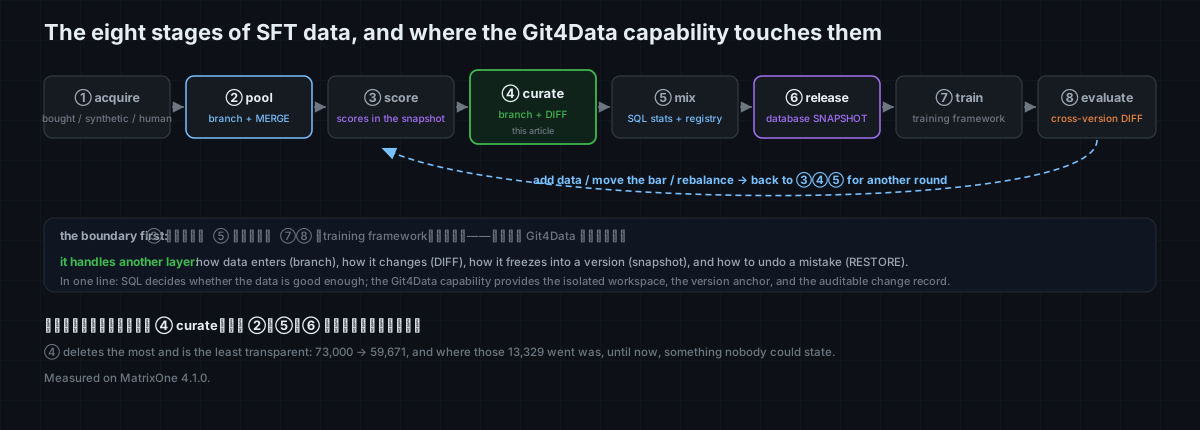
Before drilling into any detail, lay out the whole chain. A batch of SFT data goes through these stages between arriving at the team and actually being consumed by the model:
① acquire ─▶ ② pool ─▶ ③ score ─▶ ④ curate ─▶ ⑤ mix ─▶ ⑥ release ─▶ ⑦ train ─▶ ⑧ evaluate
                          ▲                                                            │
                          └────────  add data / move the bar / rebalance  ◀────────────┘
① Acquire: purchased from vendors, synthesized by a model, written by humans, or mined from production logs. Quality varies enormously between channels, and you often buy the same batch twice.
② Pool: unify sources and formats into one table, tagged with source and batch. The first trap appears right here — if a new batch is written straight into the main pool, any problem in it is instantly mixed with hundreds of thousands of good records.
③ Score: a scoring model or heuristics assign a quality score to each record; a safety classifier flags risk. Note that the scoring model has versions too — the same record can get different scores at different times.
④ Curate: dedup, apply a quality bar, filter unsafe content, remove overlap with the eval set, keep multi-turn conversations whole. This is the stage that deletes the most and is the least transparent.
⑤ Mix: decide the proportions across domains, sources, and languages. An explicit modeling decision that frequently goes unrecorded.
⑥ Release: freeze the filtered data into a definite version for training. The problem is that training reads "the pool as it was then," and the pool keeps changing.
⑦ Train → ⑧ Evaluate: with metrics in hand, go back and adjust — add data, move the bar, rebalance — returning to ③④⑤ for another round. And what exactly differs between this round's data and the last is usually something nobody can state.
Which of these eight stages belong to data version control
Let's be clear about the boundary: ③ scoring belongs to the scoring model, ⑤ mixing belongs to modeling strategy, and ⑦⑧ belong to the training framework and the evaluation system. The Git4Data capability doesn't touch those judgments. It handles a different layer — how data enters this chain, gets changed, and gets frozen into a version:
| Stage | The real problem | How MatrixOne's Git4Data capability helps |
|---|---|---|
| ② Pool | new batch, quality unknown, mustn't poison the pool | new data lands on a branch, MERGE only on pass; the pool never moves |
| ③ Score | the scoring model changes versions, so scores shift | scores enter a snapshot with the data — "which version of scores this used" stays queryable |
| ④ Curate | what was deleted, why, and can it be undone — all unclear | filter on a branch, counting before each step; DATA BRANCH DIFF reports the pass's net change |
| ⑤ Mix | the mix is a decision that leaves no trace | compute the mix in SQL before release; freeze the rule in a registry with the version |
| ⑥ Release | the pool training reads keeps changing | a database-scope CREATE SNAPSHOT freezes the version for bit-for-bit reproduction |
| ⑧ Iterate | data differences between two model versions can't be attributed | DIFF two snapshots — down to exactly which rows, removed by which filter |
| Anything goes wrong | a bad change can't be undone | RESTORE to any historical version |
The table in one line: SQL decides whether the data is good enough; the Git4Data capability provides the isolated workspace, the stable version anchor, and the auditable change record those decisions run on.
From here the article focuses on the heaviest stage, ④ curation, threading ②, ⑤, and ⑥ through one complete pass.
What's special about SFT data: it comes back to the database's home turf
In Part 10, image training data had to split into two worlds: files to lakeFS, metadata to MatrixOne. A JPEG has no rows and no columns; a database can't do much with it.
SFT data is different. One SFT sample looks like this:
{"instruction": "Explain what a database snapshot is", "response": "A snapshot is the state of...", "domain": "chat"}It's text, but highly structured: instruction in one column, response in another, plus source, language, domain, quality score, safety flag, length… the entire sample, body text included, fits directly into a table. A few hundred thousand records of a few hundred to a few thousand characters each is comfortably within a database's wheelhouse.
That gives SFT curation an advantage Part 10 didn't have: no two-world alignment is needed — everything happens on one table, in SQL, and is natively covered by row-level version semantics.
And SFT curation's actions happen to be entirely row-level:
drop duplicate samples        = DELETE some rows
cut samples below the bar     = DELETE some rows
remove eval-set overlap       = DELETE some rows
pull a source's data          = DELETE some rows
rebalance the domain mix      = selectively DELETE / keep
fix some responses            = UPDATE some rows
Every filter is a row-level change — exactly what the Git4Data capability is best at. So the thesis up front:
SFT curation shouldn't be a script that runs and vanishes. It should be a controlled change: done on a branch, audited by a DIFF, published in a fixed order and frozen as a version.
Why curation has to be auditable
Here's a scene almost every large-model team has lived through.
After sft-v7 ships, the team finds it noticeably worse than sft-v6 on coding questions — but the training code didn't change and neither did the hyperparameters; the data was just "cleaned as usual." So the question becomes: what exactly did that cleaning remove?
If curation is a pile of Python scripts that run and finish, what you typically have is: 730k records before, 600k after. What those missing 130k were, nobody can say — deduped? cut by the quality bar? did an entire domain get dropped by mistake? And reproducing the dataset sft-v6 used is hopeless, because the raw pool has taken in new data since.
That is what auditable means here. Every filter in curation should answer three questions:
- how many, and which ones (auditable);
- why (the rule is on record);
- can this version be reproduced exactly (traceable).
The case below makes all three concrete.
The running case: one SFT curation pass for a chat model
Say we maintain the SFT pool for a general chat model. The data comes from three channels: purchased vendor data, model-synthesized data, and human-written data; it spans code / math / chat / safety; and it contains both single-turn samples and multi-turn conversations.
The pool is one table — note that the body text (instruction / response) lives in the table, alongside every field the curation decisions rely on:
CREATE TABLE sft_records (
    record_id     BIGINT PRIMARY KEY,
    conv_id       BIGINT,          -- multi-turn: several rows share one conv_id
    turn_no       INT,             -- which turn within the conversation
    instruction   VARCHAR(512),
    response      VARCHAR(1024),
    norm_hash     VARCHAR(64),     -- hash of the normalized instruction (near-dup key)
    exact_hash    VARCHAR(64),     -- hash of instruction+response (exact-dup key)
    domain        VARCHAR(24),     -- code / math / chat / safety
    source        VARCHAR(32),     -- vendor / synthetic / human
    lang          VARCHAR(8),
    resp_len      INT,
    quality_score DOUBLE,          -- from a scoring model or heuristics
    is_safe       TINYINT,         -- 1 = passed the safety classifier
    ingest_batch  VARCHAR(32)
);
The two hash columns deserve a note — they catch two different kinds of duplicate:
exact_hash: hashes instruction + response together, catching identical samples — the same record sold to you by two vendors, or one batch imported twice.norm_hash: hashes only the normalized instruction (unified case, stripped punctuation and whitespace), catching near-duplicates where the question is the same but the answer differs — extremely common in synthetic data, where one prompt gets sampled several times.
The case pool: 60,000 single-turn samples + 4,000 exact duplicates + 3,000 near-duplicates + 2,000 three-turn conversations (6,000 rows), plus 800 responses truncated to empty strings and 150 conversations whose second turn was truncated — 73,000 rows measured.
Curate on a branch: six filters, each counted first
The first move matters: don't delete on the pool's main table. Branch first and do the whole pass on the branch — the pool doesn't move a row, and you can compare against it or throw the attempt away at any time. That's Part 7's Write-Audit-Publish applied to curation:
DATA BRANCH CREATE TABLE sft_curated FROM sft_records;The branch is zero-copy (Part 3 explains why), so even for a multi-million-row pool this is a millisecond operation that copies no data.
Filter 1: exact duplicates
The same "instruction + response" appearing several times makes the model overfit that sample. Group by exact_hash, keep the lowest record_id in each group:
-- how many will go
SELECT COUNT(*) AS exact_dup_rows FROM sft_curated c
WHERE c.record_id > (SELECT MIN(c2.record_id) FROM sft_curated c2
                     WHERE c2.exact_hash = c.exact_hash);
--   measured 4000

DELETE FROM sft_curated
WHERE record_id > (SELECT MIN(c2.record_id) FROM sft_curated c2
                   WHERE c2.exact_hash = sft_curated.exact_hash);
Filter 2: near-duplicates
Subtler and more common: one question with several different synthesized answers. Their exact_hash values all differ, but the normalized norm_hash is the same. Which one to keep is a policy choice (here the lowest record_id; in practice keeping the highest quality score is more common):
SELECT COUNT(*) AS near_dup_rows FROM sft_curated c
WHERE c.record_id > (SELECT MIN(c2.record_id) FROM sft_curated c2
                     WHERE c2.norm_hash = c.norm_hash);
--   measured 3000

DELETE FROM sft_curated
WHERE record_id > (SELECT MIN(c2.record_id) FROM sft_curated c2
                   WHERE c2.norm_hash = sft_curated.norm_hash);
Be clear about the boundary: norm_hash only catches near-duplicates that are identical after normalization. The semantically equivalent but differently worded kind ("what is a snapshot" vs "what does snapshot mean") escapes a hash and needs vector similarity or MinHash/SimHash. Those methods produce candidate pairs — but the final "which row to drop" is still a row-level delete, and still runs through this same flow.
Filter 3: the quality gate
Empty responses, truncated generations, and low scores from the scoring model all stay out of training:
SELECT COUNT(*) AS low_quality FROM sft_curated
WHERE resp_len < 10 OR quality_score < 0.35;
--   measured 5184

DELETE FROM sft_curated WHERE resp_len < 10 OR quality_score < 0.35;
Note that these thresholds (length 10, score 0.35) are a decision of this curation pass, not a law of nature. They must be recorded — they'll go into the curation rule at release, because the next version will very likely change them (we raise it to 0.50 at the end of this article).
Filter 4: safety
Samples flagged unsafe by the classifier are removed:
SELECT COUNT(*) AS unsafe FROM sft_curated WHERE is_safe = 0;   -- measured 101
DELETE FROM sft_curated WHERE is_safe = 0;
Filter 5: benchmark decontamination
The most dangerous filter in large-model curation. If benchmark questions leak into the SFT training set, the model memorized the answers rather than learning the ability — every benchmark number inflates, and nothing errors out. The move is an anti-join against the eval set's prompt hashes:
SELECT COUNT(*) AS contaminated FROM sft_curated c
WHERE EXISTS (SELECT 1 FROM eval_prompts e WHERE e.norm_hash = c.norm_hash);
--   measured 744

DELETE FROM sft_curated
WHERE EXISTS (SELECT 1 FROM eval_prompts e WHERE e.norm_hash = sft_curated.norm_hash);
The same honesty as Part 10 applies: this anti-join matches prompts that are identical after normalization. Rewritten, translated, or reworded contamination escapes it — catching that needs a semantic-similarity layer over the eval set. Hash decontamination is the floor, not the ceiling.
Filter 6: multi-turn integrity
This filter is specific to SFT, and the one scripts most often miss. A multi-turn conversation must enter and leave as a whole: if turn 2 was dropped by filter 3 because its response was truncated, a conversation left with only turns 1 and 3 is broken and harmful — the model learns jumpy, incoherent dialogue structure.
So after every filter, sweep once more: which conv_ids no longer have all their turns, and drop those whole:
SELECT COUNT(*) AS broken_conv_rows FROM sft_curated c
WHERE c.conv_id IN (
  SELECT conv_id FROM sft_curated GROUP BY conv_id HAVING COUNT(*) < MAX(turn_no)
);
--   measured 300 (150 conversations, each left with two turns after one was cut)

DELETE FROM sft_curated WHERE conv_id IN (
  SELECT conv_id FROM (
    SELECT conv_id FROM sft_curated GROUP BY conv_id HAVING COUNT(*) < MAX(turn_no)
  ) t
);
This is why curation order matters: the integrity check must come after all the filters, because what it cleans up is precisely the collateral damage the earlier filters caused.
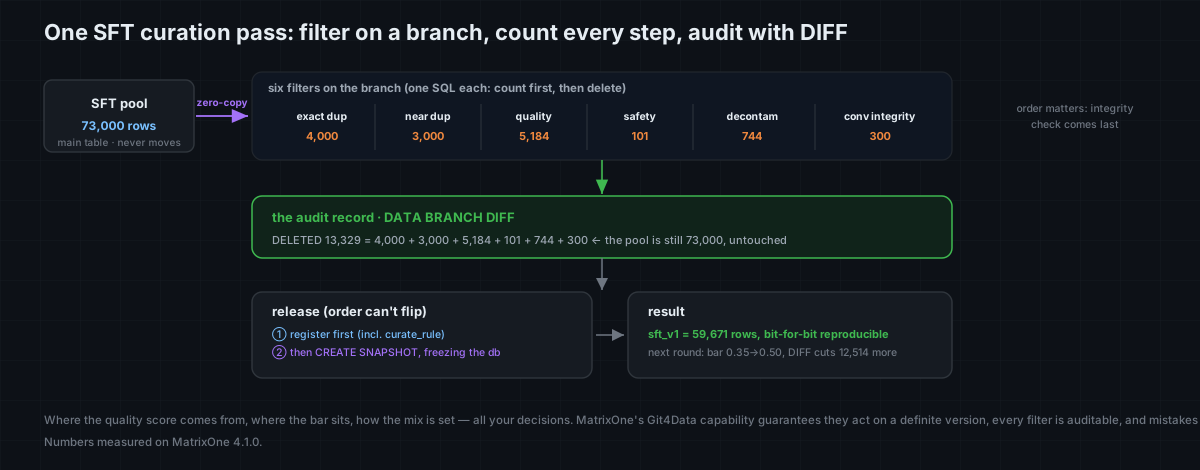
After six filters: 73,000 → 59,671 rows, measured.
The audit record: DIFF gives the net change, the process records the reasons
With the pass complete, the important move — record what it did:
DATA BRANCH DIFF sft_curated AGAINST sft_records OUTPUT SUMMARY;
--   measured INSERTED 0 / DELETED 13329 / UPDATED 0
13329 isn't an estimate; it's the sum of the six filters: 4000 + 3000 + 5184 + 101 + 744 + 300 = 13329. The pool never moved a row, and this pass's entire impact compresses into one summary line.
One thing needs stating precisely: OUTPUT SUMMARY returns the branch's net change against the pool (INSERTED / DELETED / UPDATED), not a per-row reason for each deletion. There is no "this row was cut by the safety filter" column in the table, and DIFF cannot invent one. Grouping by reason comes from the process itself — each filter runs COUNT before DELETE, so those six numbers are the six reasons, and they add up exactly to the DIFF total. If you need stronger traceability, there are two routes: take a DIFF after each filter, so every step carries its own net-change number; or, before deleting, write the matched primary keys along with (step, reason) into a curation log table. The registry's curate_rule records the rule, not a per-row verdict.
So three things are certain here: the pool never moved a row; this pass's net impact is a definite, queryable number; and both the rule and the number get frozen with the version.
The data is already in tables, so you can keep asking questions before release — starting with this version's mix:
-- before publishing, look at the mix: domain and source ratios are themselves curation decisions
SELECT domain, COUNT(*) AS n,
       ROUND(100.0 * COUNT(*) / (SELECT COUNT(*) FROM sft_curated), 1) AS pct
FROM sft_curated GROUP BY domain ORDER BY domain;
--   measured chat 18896 (31.7%) / code 13247 (22.2%) / math 13764 (23.1%) / safety 13764 (23.1%)

SELECT source, COUNT(*) AS n FROM sft_curated GROUP BY source ORDER BY source;
--   measured human_written 23591 / synthetic_gpt 18040 / vendor_a 18040
Both groups total 59,671, matching the row count left after the DIFF above — doing that reconciliation before release catches most "the numbers in the doc aren't the numbers in the version" problems.
These queries also surface something easy to overlook: the mix is part of curation too. Chat at 31.7% and code at only 22.2% — does that match this run's goal? Synthetic data (synthetic_gpt) at nearly a third — is that too high? There's no universal answer, but these judgments must be seen before release, not guessed at after training produces a strange model.
Release: register, then swap, then snapshot
Only after the audit passes do we publish. Two details are worth stressing.
First, register before you snapshot. We want "this dataset version = which snapshot + which curation rule" recorded as a queryable binding. The order must be write the registry first, take the snapshot second — otherwise the binding sits only in the mutable live database, never frozen into the version:
CREATE TABLE dataset_registry (
    dataset_version   VARCHAR(32) PRIMARY KEY,
    metadata_snapshot VARCHAR(64),
    n_records         BIGINT,
    curate_rule       VARCHAR(256)
);

-- register first (the snapshot name is chosen up front, so this row can name it)
INSERT INTO dataset_registry
SELECT 'sft_v1', 'sft_v1', COUNT(*),
       'exact+near dedup, len>=10, score>=0.35, safe only, eval-decontam, whole-conv'
FROM sft_curated;
Note the curate_rule column: it makes "the rules this version was filtered by" part of the data. Three months later, when someone asks what v1's quality bar was, it's one SELECT — not an archaeology trip through the script repo's git log.
Second, the swap and the freeze are a fixed sequence of statements, not one transaction. Replace the pool with the curated branch, then snapshot to freeze the whole version:
DROP TABLE sft_records;
ALTER TABLE sft_curated RENAME TO sft_records;   -- the curated pool becomes the pool
CREATE SNAPSHOT sft_v1 FOR DATABASE sft_pool;

-- the binding is now inside the snapshot, not just the live db
SELECT n_records FROM dataset_registry {SNAPSHOT='sft_v1'} WHERE dataset_version = 'sft_v1';
--   measured 59671
To be honest about it: there is no atomicity across these three statements. On 4.1.0 they commit independently, and if any one fails the earlier ones do not roll back — a successful DROP followed by a failed RENAME leaves the pool temporarily absent. So the right way to run this step is: snapshot the current pool first as a rollback point, then execute in the order above, confirming each statement before moving on, and RESTORE to the previous version if something fails.
Put differently, what this flow guarantees is not "one command that either fully succeeds or fully doesn't." It's that the release order is deterministic, each step's result is verifiable, and every version has a rollback anchor. What actually gets frozen and reproduced bit for bit is the result of that final CREATE SNAPSHOT — until it succeeds, the version isn't published.
The next round: v2's audit record, and v1 still reproducible
Weeks later the team decides to tighten the quality bar — from 0.35 to 0.50. Same flow again, and this time the DIFF tells you what that decision costs:
DATA BRANCH CREATE TABLE sft_v2_wip FROM sft_records;
DELETE FROM sft_v2_wip WHERE quality_score < 0.50;

DATA BRANCH DIFF sft_v2_wip AGAINST sft_records OUTPUT SUMMARY;
--   measured DELETED 12514
SELECT COUNT(*) AS v2_rows FROM sft_v2_wip;   -- measured 47157
Moving one threshold from 0.35 to 0.50 costs another 12,514 records — the dataset drops from 59,671 to 47,157, down 21%. That number belongs on the table before training starts, not after the model comes out dumber and someone starts guessing.
Meanwhile v1 remains queryable, untouched:
SELECT COUNT(*) AS v1_rows FROM sft_records {SNAPSHOT='sft_v1'}; -- measured 59671So the opening problem — "sft-v7 regressed on coding" — now has an executable investigation path: DIFF the data snapshot v7 used against v6's, see which code-domain rows disappeared and which filter removed them. For the first time, a model regression lands on specific data changes.
The industry's other approaches: how SFT curation usually gets managed, and where each gets stuck
Making SFT curation "auditable, reproducible, reversible" has a few common paths, each solving part of it:
Approach 1: a pile of Python cleaning scripts producing a new file. The most common. clean_v3.py runs and emits sft_train_v3.jsonl. Flexible; the cost is that neither the result nor the process is queryable — you have a 600k-line file but no record of "which 13,329 went, and why"; reproducing the previous version depends on both the script and the raw pool being unchanged.
Approach 2: scripts plus keeping every intermediate artifact. Disciplined teams do this: step1_dedup.jsonl, step2_quality.jsonl… It is traceable, at the cost of a full copy per step (N× storage), and comparing two versions means writing more scripts — you can't just JOIN or aggregate.
Approach 3: HuggingFace Datasets versioned on the Hub. The dataset gets revisions (every Hub repo is a git repo, so any commit is retrievable), with a strong ecosystem. But in this workflow the traceable granularity is the dataset revision: it can tell you v3 isn't v2; saying "these 300 rows went because their conversations were left incomplete" is something you have to record yourself in the script. The filtering logic still lives in external scripts too.
Approach 4: data-version tools like DVC / lakeFS. They pin JSONL files to versions you can return to, which is solid. But what they see is files: the diff is file- or object-level, while SFT curation's semantics are entirely row-level; and with the data in files, computing "the domain mix" means reading it back first.
Approach 5: curation in a data warehouse (Spark / BigQuery, …). Filtering in SQL matches this article's approach and is common at larger teams. The difference is version semantics: keeping each version in Spark usually means writing to a new date-suffixed table, or leaning on Delta/Iceberg table versions; row-level branch / diff / merge isn't native, so "try a curation pass on a branch and throw it away if it's bad" has to be assembled by hand.
Put in one table. First, the table's scope: it compares the default path of each workflow listed above, not the full capability of the products involved — treat each vendor's own documentation as authoritative (see References). Most of the "no" cells can be filled in with extra engineering; the cost is that you build and maintain it yourself.
| Approach | Row-level audit record (which rows) | Where the filtering lives | Version reproducible | Cost of a failed attempt | Extra copies |
|---|---|---|---|---|---|
| Python scripts + output file | none | scripts | on discipline | re-run everything | one per version |
| Scripts + intermediate artifacts | partial (by diffing files) | scripts | yes | re-run | N× |
| HF Datasets + Hub | no (dataset level) | external scripts | yes | re-upload | one per version |
| DVC / lakeFS | no (file level) | external scripts | yes | re-run | deduped, cheaper |
| Warehouse SQL (Spark, …) | no (table-version level) | SQL ✅ | yes | new table | one table per version |
| MatrixOne (Git4Data capability) | yes (DATA BRANCH DIFF) | SQL ✅ | yes (snapshot) | zero-copy branch, just drop it | none |
In one line: among the paths listed here, they either lock the filtering logic in scripts and leave you a file (the script family), or version the data without row-level semantics (file-version tools), or let you filter in SQL without native branching and row-level diff (warehouses). What's different about MatrixOne is that all three hold on one table at once: curation written in SQL, tried on a zero-copy branch, net change reported by DATA BRANCH DIFF, then published in a fixed order and frozen with a snapshot.
Boundaries and applicability
- The Git4Data capability doesn't judge quality for you. Where the quality score comes from (a scoring model, rules, humans), where the bar sits, how the mix is set — all your decisions. What it guarantees is that those decisions act on a definite data version, the results are auditable, and mistakes can be rolled back.
- Hash dedup and hash decontamination are the floor, not the ceiling. Semantic near-duplicates and reworded contamination need vector retrieval or MinHash-style methods to produce candidates first; but once candidates exist, "which rows to drop" comes right back to the row-level flow here.
- Multi-turn integrity must be checked explicitly. It doesn't hold by itself, and it has to come after every filter — the 300 rows measured here were collateral damage from the earlier filters.
- Snapshots have retention cost. Keep the
sft_vNfor each shipped model long-term, and set a cleanup policy for abandoned trial versions, or historical versions will hold storage indefinitely.
- Curation rules should travel with the version. Writing the thresholds and rules into the registry (this article's
curate_rulecolumn) is far more reliable than a comment in some script.
- Release is not a single atomic command.
DROP/RENAME/CREATE SNAPSHOTeach commit independently; keeping the release controlled relies on "snapshot a rollback point first, verify every step."
References
- OpenAI, Aligning language models to follow instructions (InstructGPT) | paper: arXiv:2203.02155 — SFT demonstration-set size and the RLHF chain
- Zhou et al., LIMA: Less Is More for Alignment — alignment from 1,000 curated samples
- HuggingFace, Repositories getting started (revision / commit semantics)
- DVC quickstart (file / directory versioning)
- lakeFS, Branching quickstart (zero-copy branches over object storage)
- Apache Spark, Spark SQL Programming Guide
- Google Cloud, BigQuery introduction
Closing
SFT's data volume is orders of magnitude smaller than pretraining's, while each sample's effect on model behavior is far more direct. That's exactly why every curation decision imprints on model behavior — and why this has long been the least transparent link in the chain: a pile of scripts runs, the pool shrinks a lot, and what went, why, and whether it can be undone rests on memory and discipline.
Replace that with "do it on a branch, count before each filter, let DIFF report the net change, publish in a fixed order, freeze with a snapshot," and the link becomes as controllable as code review: 73,000 → 59,671, and which filter each of those 13,329 belongs to reconciles in one SQL; raising the bar from 0.35 to 0.50 costs 21% of the data, and that price is on the table before training starts; and any historical version can be reconstructed bit for bit at any time.
📎 Runnable SQL (pinned to commit
354b9cf): github.com/matrixorigin/git4data-tutorial | Source & community: github.com/matrixorigin/matrixone